Skip to main content

Why great shopping experiences need commercial logic built in.
On this page
Definition
The experience engine creates and personalizes the shopper interaction. The commerce engine connects that interaction to products, rules, baskets and ongoing customer relationships. In ARview, Experience Studio and the Agentic Commerce Hub are the two product concepts, and each of the 8 specialist agents can draw on both.

A virtual try-on can help a shopper discover a product. A skin diagnostic can identify individual needs. But neither one, on its own, creates a relevant recommendation, a complete basket or a lasting customer relationship.
That takes two capabilities working together: an experience engine that understands and engages the shopper, and a commerce engine that turns those interactions into product choices and commercial action. ARview brings both into one modular agentic commerce platform. Aria, a domain-specific AI model trained on each brand’s own data, powers 8 specialist agents.
Most AI in retail is added to one end of the journey. A try-on or a chatbot helps shoppers explore, and the commercial side stays somewhere else: in the catalog, the promotion rules, the basket and the loyalty program.
When those sit in separate workflows, the shopper gets a good moment and the brand gets a disconnected one. The recommendation does not reflect what is in stock or what the brand is allowed to say, and what the brand learns from the interaction does not reach the next decision.
The design question for any agentic commerce platform is how experience and commerce are connected, not whether each exists.
The experience engine creates and personalizes the shopper interaction. Its capabilities include skin analysis and diagnostics, virtual try-on, guided discovery, personalized consultations, and interactive gifting and fragrance discovery. It lives in Experience Studio, where brands build what their shoppers meet. Its test is whether the shopper feels accurately seen and clearly guided.
The commerce engine connects shopper intent to products and commercial action. Its capabilities include product matching and relevance, basket composition, commercial rules and availability, loyalty and retention actions, and cross-sell. It lives in the Agentic Commerce Hub. Its test is whether what is recommended is right for the shopper and workable for the brand.
Experience Studio and the Agentic Commerce Hub are two offerings that can each be adopted on their own, and they are designed to work as one platform. Different teams can configure and measure different capabilities without splitting the customer journey in two:
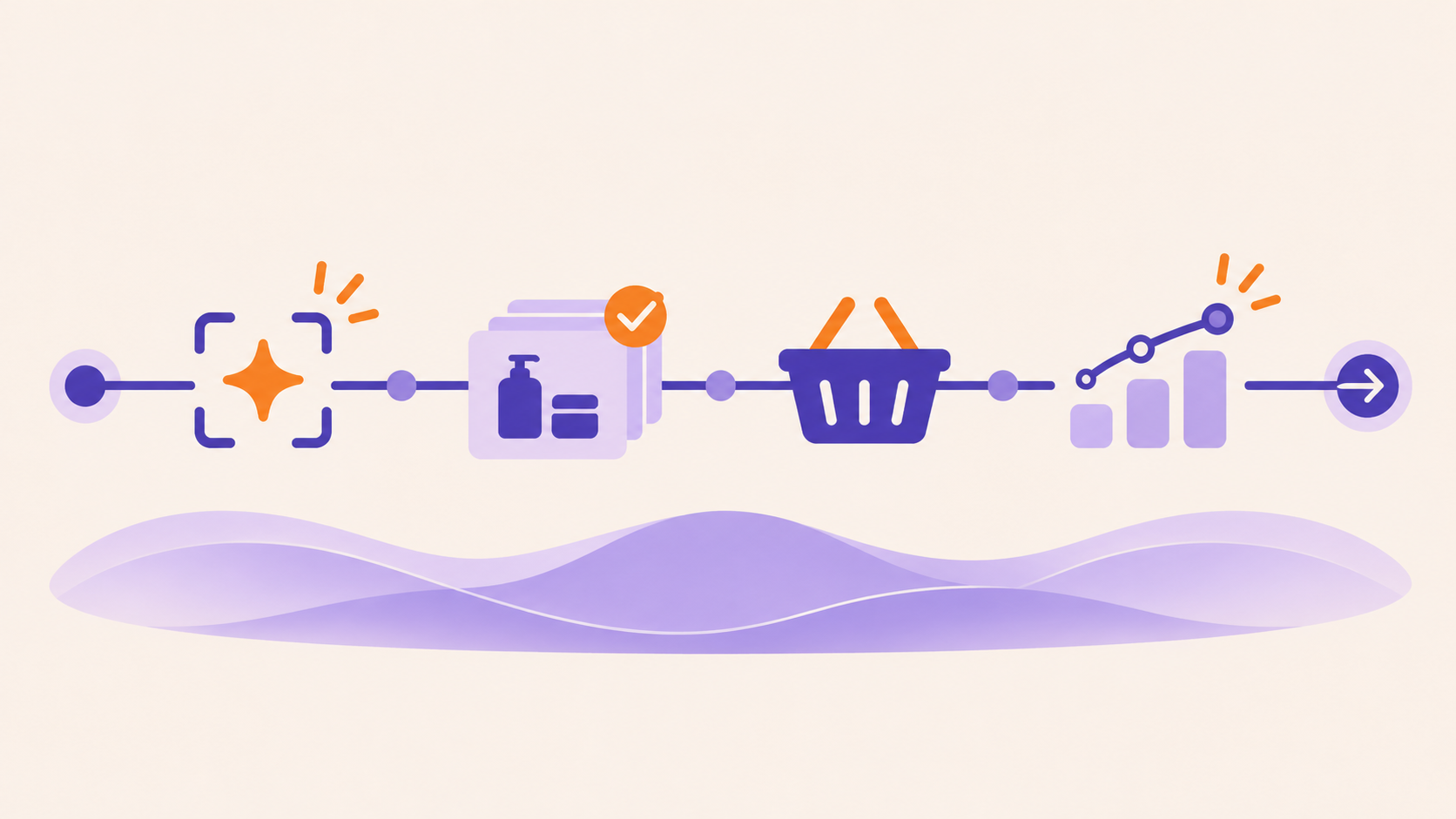
A conceptual journey to show how the engines work together.
An illustrative example. A shopper’s scan shows dehydrated skin and a preference for fragrance-free products. The commerce engine checks that against the brand’s catalog and rules and finds that the best-fitting moisturizer is out of stock in her market. Instead of a confident answer for the wrong shelf, she gets the next-best option with a clear explanation. Across many shoppers, the brand can also see where its assortment has gaps.
Either engine can be adopted on its own. What a retailer loses without the connection is the connected journey: without the commerce engine, an analysis can end in generic advice, and without the experience engine, a recommendation can arrive with no understanding of the person it is for.
ARview’s 8 specialist agents are Try-on, Skin Diagnostics, Routine, Personalization, Basket Building, Loyalty, Gifting and Fragrance. They are not sorted into one engine or the other, because most of them work across both. A gifting agent guides discovery and also assembles a purchase. A routine agent gives skincare guidance and also builds a complete regimen to buy. Personalization shapes the experience and the recommendation alike.
Aria, a domain-specific AI model trained on each brand’s own data, powers these agents. It is one part of a hybrid system: computer vision handles skin and face analysis, product data supplies catalog facts, explicit rules set what a brand may claim, and language models rank and explain options within those limits. The platform is model- and cloud-agnostic, so retailers choose what it connects to.
Each retailer’s data stays inside its own tenant ecosystem. ARview does not store images. Each image is processed in real time to generate insights (metrics), and only those insights are kept and passed to the next agent. The platform learns continuously from scans, try-ons and purchases, so what the brand sees about its own customers grows with every interaction.
The experience earns attention. Commercial intelligence makes that attention useful.
Is each of the 8 agents part of only one engine?
No. Most agents work across both. A gifting agent, for example, guides the shopper and also assembles a purchase.
Is Aria one of the 8 agents?
No. Aria is the domain-specific AI model, trained on each brand’s own data, that powers the 8 specialist agents.
Do we need both engines from day one?
No. Experience Studio and the Agentic Commerce Hub can each be adopted on their own, and the agents are modular.
See how the experience engine and the commerce engine work together inside ARview.
Book a demo