
The beauty market has never sold more, and shoppers have never had a harder time finding what suits them. Those two facts sound contradictory. They're actually the same problem, and it has a name.
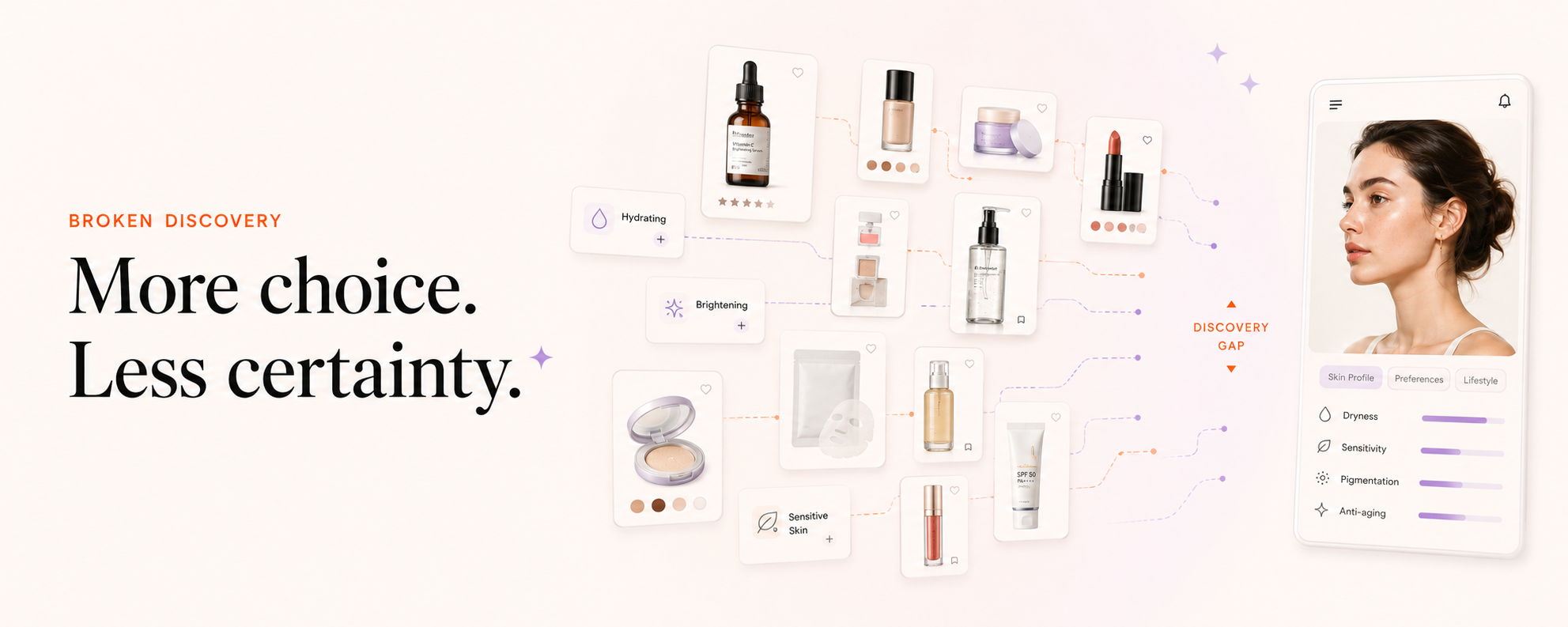
The discovery gap is the widening distance between market supply, the total volume of products, brands and claims for sale, and individual fit, the small subset of that supply which actually suits a specific person's skin, tone and needs. Supply is growing fast. A shopper's ability to find her fit inside it is not. The space between those two lines is the gap, and it's where satisfaction, margin and loyalty quietly leak out.
The short version
What is the discovery gap?
The discovery gap is the growing mismatch between supply and fit in a category. On one axis, market supply expands: more SKUs, more brands, more claims, more channels. On the other, individual fit stays flat or shrinks, because a single shopper can still only evaluate a handful of options and still lacks an easy way to know which ones suit her.
.png)
Beauty is where the gap is widest, because fit here is unusually specific. The right foundation depends on undertone and finish. The right serum depends on skin type, concern and what a shopper is already using. Two people standing in the same aisle need almost entirely different products, yet the store shows them the same grid. As supply grows and fit stays personal, the gap widens by default.
How big is the beauty market, really?
Big, and growing faster than most consumer categories. Statista projects the global beauty and personal care market at around US$698 billion in revenue in 2026 (Statista), and McKinsey has tracked the industry growing roughly 5% a year in recent years, outpacing much of consumer goods (McKinsey, State of Beauty).
That growth shows up as choice. Product ranges, brand counts and claim types have multiplied, and the evidence is that it has passed the point of helping shoppers. In a field experiment across more than 1.6 million consumers, choice overload was most pronounced in exactly three categories, and beauty was one of them (UCLA Anderson Review). More supply stopped translating into more found.
If there's more choice than ever, why can't shoppers find what suits them?
Because choice is not the same as findability. Three things break in the gap.
The first is choice overload. Past a certain point, more options don't empower a shopper, they paralyze her. She scrolls, second-guesses and retreats to the bestseller she already knew or leaves with nothing.
.png)
The second is the vocabulary problem. Search assumes the shopper already knows the words for what she wants. Beauty need is sensory and personal before it is verbal, so a shopper who can't name "peachy neutral undertone" or "non-comedogenic barrier repair" can't type it either, and the search box has nothing for her.
The third is measurable, and large. Sixty-eight percent of online shoppers will leave a site because of a poor search experience (Threekit). More than three in four US consumers, 76%, say they have searched a retail site and not found the item, on average four times in a single month (Google Cloud). These aren't people who don't want to buy. They're people the site couldn't guide.
What does the discovery gap cost brands?
More than most teams measure, because the cost hides in two places: baskets that never convert, and orders that come back.
On the front end, search abandonment, when a shopper looks for something and doesn't find it, costs retailers more than $2 trillion globally each year, and more than $234 billion in the US alone (Google Cloud). Roughly half of shoppers will abandon an entire basket if there's even one item they can't find.
.png)
On the back end, poor fit comes home as returns. Beauty return rates run from about 4% to 12% overall, but color cosmetics reach 12% to 25% and foundation and concealer climb to around 23% where returns are allowed (beauty returns benchmarks). The reason is overwhelmingly fit, not defect: analyses find roughly 64% of beauty returns happen because the product looked different in person than on screen (Mintoiro). A shade guessed wrong is a sale that reverses, plus shipping, restocking and a shopper who trusts the next purchase a little less.
Add it up and the gap taxes a brand twice: once for the customer who never found the product, and again for the one who found the wrong one.
Why do filters and bestsellers make the gap worse?
Because the two default tools for narrowing a big catalog both work against fit.
Filters still require vocabulary. A filter for "undertone" only helps a shopper who knows hers. Filters reduce the list, but they don't answer the underlying question of what suits me, so they mostly serve the shoppers who were already close to deciding.
Bestseller sorts and "customers also bought" optimize for what is already popular, which surfaces the same small set of products regardless of who's looking. The distinctive, higher-margin long tail, often the best fit for a specific shopper, stays buried. The gap isn't a bug in these tools. It's what they were built to do.
How do you close the discovery gap?
By replacing the query box and the filter wall with guided discovery that starts from the shopper, not the catalog. The move is to capture what a shopper actually needs, through a conversation, a scan or a set of preferences she can express in her own terms, then translate that into the specific products that fit, with the reasoning attached.
This is the problem we built ARview to solve. Its skin diagnostics read 15+ markers from a camera scan and match products to a shopper's real skin, and its virtual try-on lets her see a shade on herself before she buys, so fit is settled before checkout rather than discovered at the mirror. Brands using this approach see add-to-basket rise and returns fall, because the shopper is matched rather than left to guess.
.png)
The gap in numbers
The supply side (growing)The fit side (stuck)~US$698B global beauty market in 2026 (Statista)76% of shoppers have searched and not found the item (Google Cloud)~5% annual industry growth (McKinsey)68% leave a site over a poor search experience (Threekit)Beauty among the top categories for choice overload (UCLA Anderson)~64% of beauty returns caused by mismatch vs screen (Mintoiro)Expanding SKUs, brands and claims>$2T lost to search abandonment globally each year (Google Cloud)
The market keeps adding supply. The shopper's ability to find her fit is where the work now is.