

Gift shopping exposes a structural weakness in ecommerce. The shopper begins with a person, an occasion and a budget. Most retailer websites require them to convert that context into product categories, keywords and filters.
That model is now being challenged by social commerce and AI search, where product discovery begins with intent rather than catalogue structure. With Christmas around the corner, the gap between the two has never been more visible.
Discovery is spreading beyond the brand’s website
Social platforms are no longer only where shoppers find products. They are increasingly where they buy them. TikTok Shop recorded its highest sales day in UK history on Black Friday 2025, selling 27 items every second, and beat the previous year’s performance by 50% across the full Black Friday to Cyber Monday period. Searches for “TikTok Shop Black Friday” rose 404% over the main weekend, and the number of people shopping on the platform grew 28% year on year.
AI is driving a parallel shift. Salesforce reports that the share of traffic from third party AI search channels such as ChatGPT and Perplexity doubled during the 2025 holiday season, and that shoppers referred from those channels converted nine times more often than shoppers arriving from social media. In the UK, John Lewis says searches from AI agents have risen to 2.5% from 0.3% a year earlier, and that the trend is accelerating.
Product discovery is spreading across social and AI platforms, while the brand’s own environment remains where it can control product truth, customer experience and first party intelligence.
Customer service chat is not conversational commerce
Many retailers already use chatbots. Most were designed to answer questions about orders, delivery and returns. They reduce contact centre demand, but they do not help a shopper decide what to buy.
A selling agent has a different job. It must interpret an open ended need, reason across the catalogue, compare alternatives, explain a recommendation and move the shopper to the next commercial step. The data shows how early that capability still is.
What the data supports
- 20% of retail and CPG respondents have active AI agents. Live agent deployment remains early. (NVIDIA)
- 21% plan deployment within one year. The adoption window is opening quickly. (NVIDIA)
- 1 in 3 ecommerce sites are forecast to offer shopping agents by Cyber Week 2026. Most sites may still enter peak without one. (Salesforce forecast)
- 6.2% versus 3.9% holiday sales growth among retailers with their own agents versus those without. Agent deployment correlated with faster sales growth in Salesforce data; correlation, not causation. (Salesforce)
Retail has taught chat how to answer service questions. It is only beginning to teach it how to sell.
Gifting is a decision problem, not a choice problem
Holiday shoppers are not short of options. They are weighing the recipient, the relationship, the budget, what the gift will communicate and the risk of getting it wrong.
A search for “men’s fragrance under £100” retrieves products that match words. A conversation such as “he likes warm, woody scents but nothing heavy, travels constantly, and I want something personal without much risk” reveals the context needed to make a recommendation.
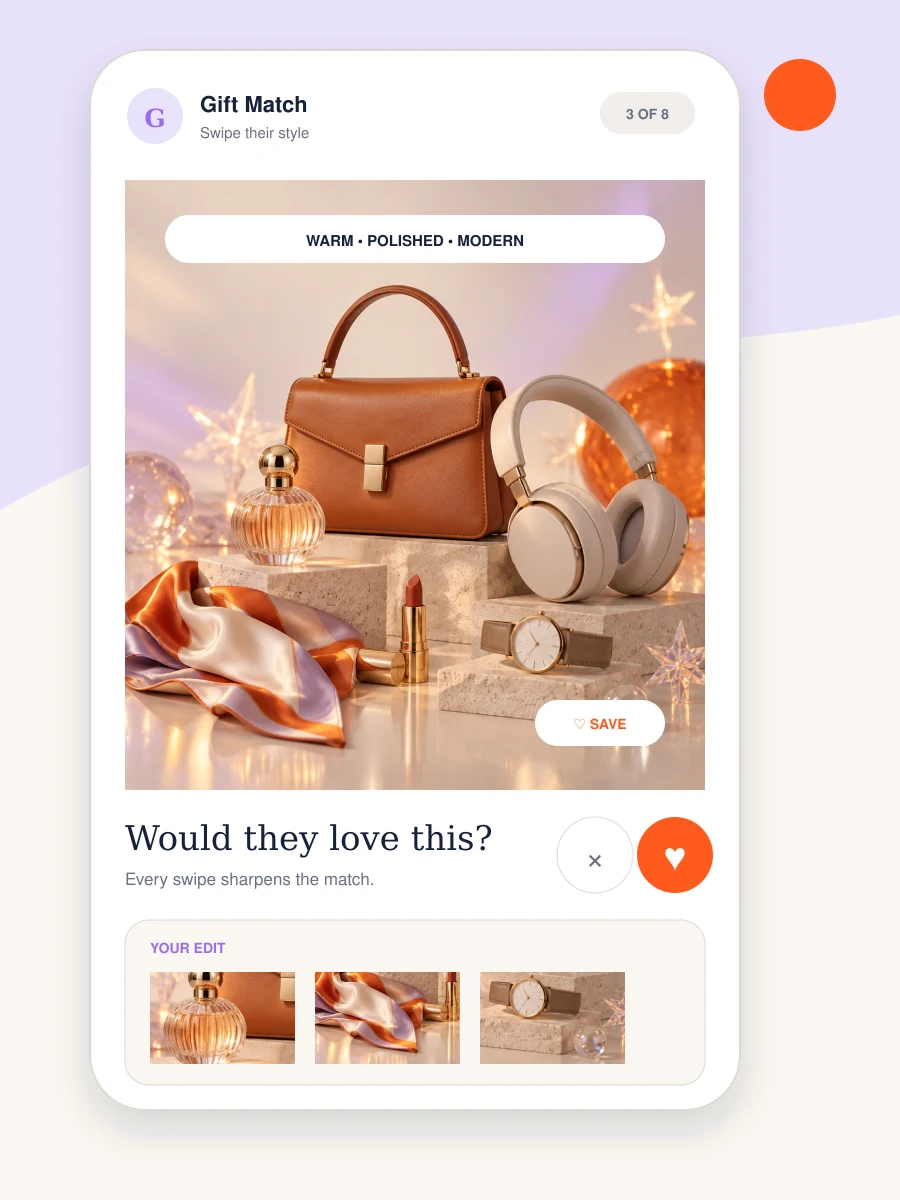
Not every shopper can articulate taste in words. Visual preference signals, including swipe based discovery, can help an agent learn what the shopper responds to before narrowing the catalogue.
External reach versus owned intelligence
The world’s largest beauty group has already moved. L’Oréal announced a collaboration with OpenAI at VivaTech 2026 in which Maybelline New York will bring its virtual makeup try-on directly into ChatGPT, powered by L’Oréal’s ModiFace technology. L’Oréal will also work with OpenAI to strengthen product discovery for its brands within ChatGPT in the US, while SkinCeuticals, CeraVe and Garnier take part in ChatGPT’s global ad pilot.
The partnership confirms where the category is heading: conversational discovery, visual try-on and purchase intent combined in one journey. It also shows that the largest brands will build presence inside third party AI platforms, where those platforms shape the interface and the experience.
That reach matters. But it does not replace what a brand learns in its own environment: why shoppers choose, where they hesitate and what the catalogue fails to offer. Few brands can negotiate a partnership at L’Oréal’s scale. All of them can decide what intelligence they want to own.
The world’s largest beauty group is building discovery inside a third party AI platform. Every brand also needs discovery it owns.
A shopping agent is only as good as the commerce system behind it
An agent that talks fluently but does not understand the catalogue is still a chatbot. A credible shopping agent needs five capabilities working together.
Product intelligence. Accurate, structured product data, including ingredients, shades, sizes, materials, claims and use cases. In Salsify’s consumer research, 31% of shoppers said detailed product descriptions and specifications most helped them trust AI recommendations.
Intent intelligence. The ability to translate natural language, preferences and constraints into product criteria, and to recognise when one more question is needed.
Commercial intelligence. Inventory, pricing, promotions, delivery cut offs and merchandising priorities. The most relevant gift is useless if it cannot arrive before Christmas.
Action. A direct route to the product, the basket, a bundle or checkout. Without action, the experience remains advisory rather than agentic.
Governance and measurement. Control over what the agent can recommend, claim and execute, measured in commercial terms: add to basket rate, conversion, average order value, bundle attachment, time to decision and return rate. Conversation volume is not a success metric.
The shopper must stay in control
Not every shopper wants to hand decisions to AI. In Salsify’s 2026 Holiday Pulse survey of 1,212 shoppers across the US, UK and Canada, 28% said they would not delegate any part of their holiday shopping to an AI assistant because they want full control. But 40% said they would be comfortable delegating the discovery of gift ideas for loved ones, the most popular task in the survey, and 37% would use AI to research and compare options to find the best gift.
Trust is also shaped by familiarity. Only 20% were comfortable with AI suggesting brands and gifts they did not already know, compared with 23% for brands they did. That matters for brands: the agent shoppers meet in a brand’s own environment starts with a relationship already in place.
Conversational shopping should therefore be an additional path for customers who want guidance, not a replacement for browsing. Shoppers should understand why something was recommended, change direction easily and make the final decision themselves.
Before Christmas: a practical checklist
- Start with a curated holiday selection rather than the full catalogue.
- Check that product data answers what gift buyers ask: ingredients, shades, sizes and set contents.
- Choose a deployment format that fits your peak season constraints: a campaign page, shareable experience or lightweight site integration.
- Define commercial success metrics before launch.
- Plan to reuse the insight for Valentine’s Day and Mother’s Day.
Holiday 2026 as a pressure test
The first wave of retail AI was measured on efficiency. The next will be measured on revenue. With Christmas around the corner, the season concentrates everything that makes that test hard: higher traffic, broader intent, fast changing stock, fixed delivery deadlines and shoppers buying for someone else.
The brands that pass will not be the ones with the most impressive demo. They will be the ones whose customers chose with more confidence, and whose teams learned why.
Sources
- TikTok Newsroom — TikTok Shop UK Black Friday 2025
- Salesforce — 2025 holiday shopping data
- Salesforce — 2026 peak holiday predictions
- NVIDIA — State of AI in Retail and CPG 2026
- Reuters — John Lewis and AI agent search, 3 September 2026
- L’Oréal — L’Oréal and OpenAI join forces, 17 June 2026
- Salsify — 2026 Holiday Pulse Report (n=1,212)
- Salsify — 2026 holiday shopper insights