
How guided discovery can move shoppers beyond familiar products, bestseller loops and pre-formed intent.
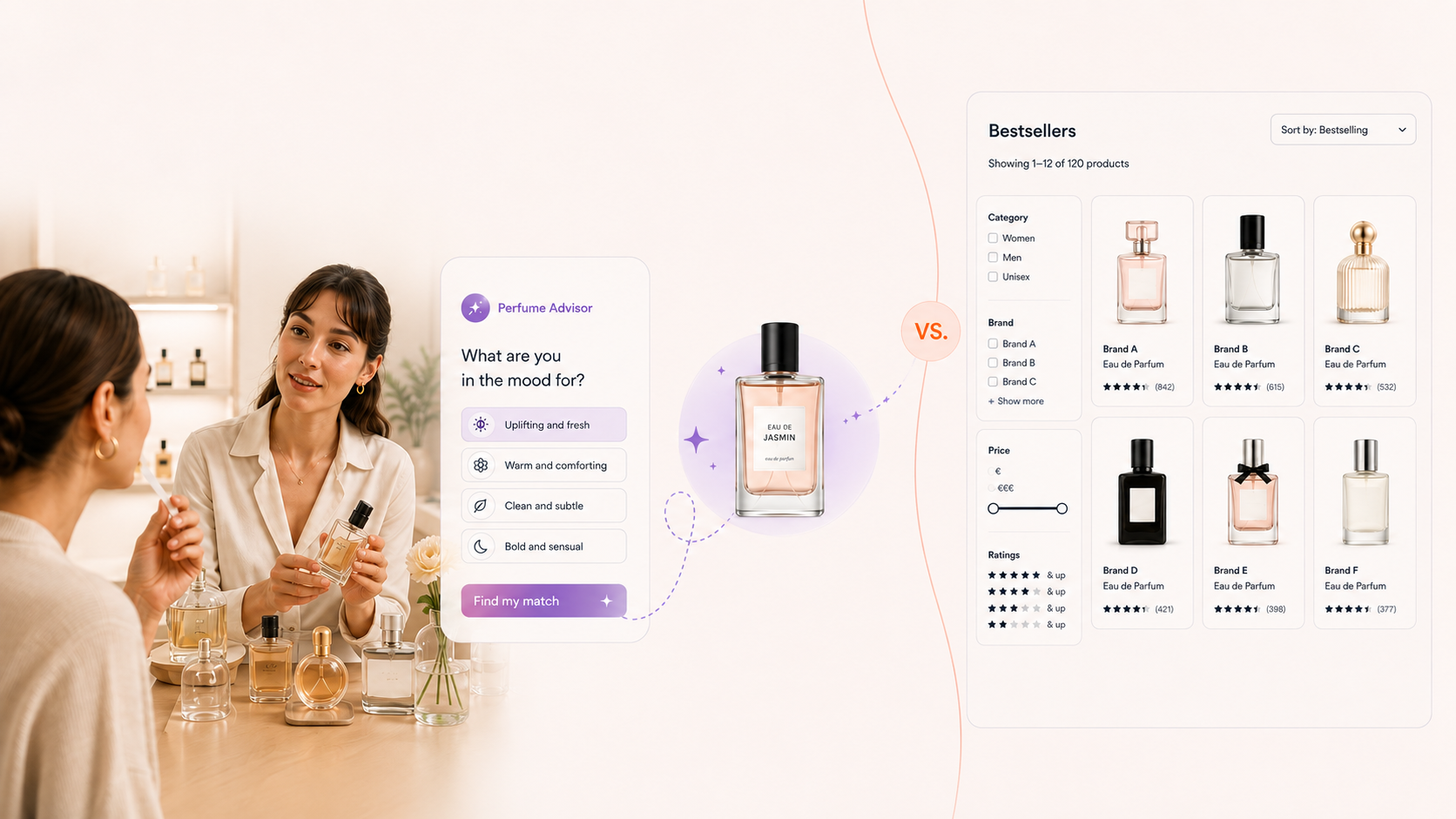
Walk into a great perfumery and the advisor doesn't ask you to filter by price, brand and bottle size.
They ask what you're drawn to.
Woods or florals? Morning or evening? Something that announces you, or something only the people close to you notice?
Ten minutes later you're holding a fragrance you didn't know existed and couldn't have searched for, because you didn't have the words.
Online, we replaced that conversation with a grid sorted by bestselling.
The popularity trap
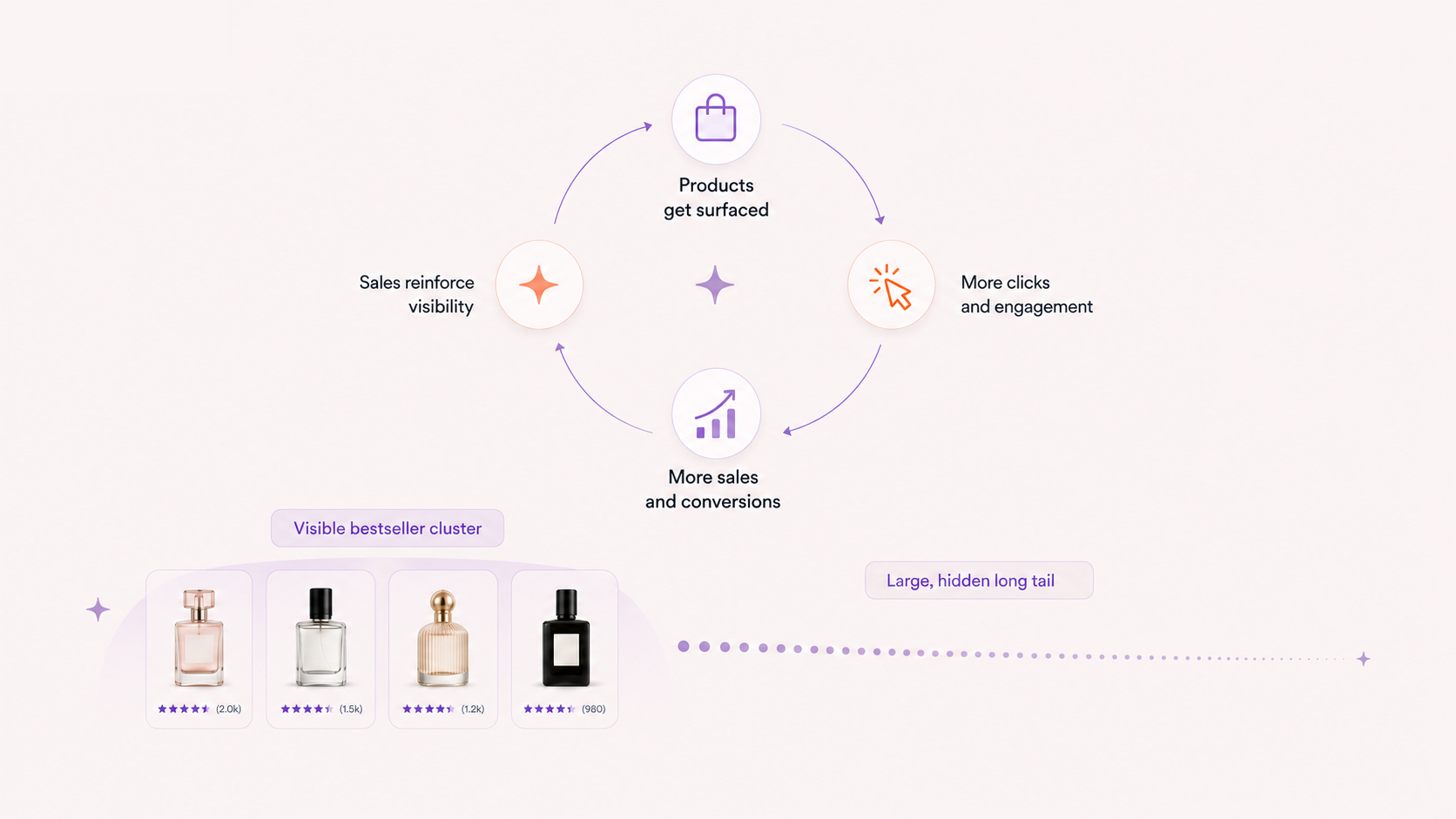
Much of e-commerce discovery still disproportionately rewards what is already popular: bestseller sorts, review counts, customers also bought, trending products and recommendation systems heavily informed by past purchase behavior.
The logic quickly becomes circular.
Products get surfaced because they sell, and they sell because they get surfaced.
For the shopper, this creates the strange experience of standing in front of an almost infinite catalog that somehow keeps showing the same forty products.
For brands and retailers, the cost is quieter but potentially much larger.
The long tail often contains some of the most distinctive and strategically valuable products in the assortment: products that differentiate the retailer, deepen loyalty, create new occasions for purchase and, in many cases, carry attractive economics.
Yet those products can become commercially invisible simply because they lack enough historic interaction to earn more exposure.
The shopper who might have fallen in love with something in that tail leaves with a safe bestseller, or with nothing at all.
Discovery isn't a UX problem. It's a merchandising and margin problem wearing a UX costume.
The vocabulary gap
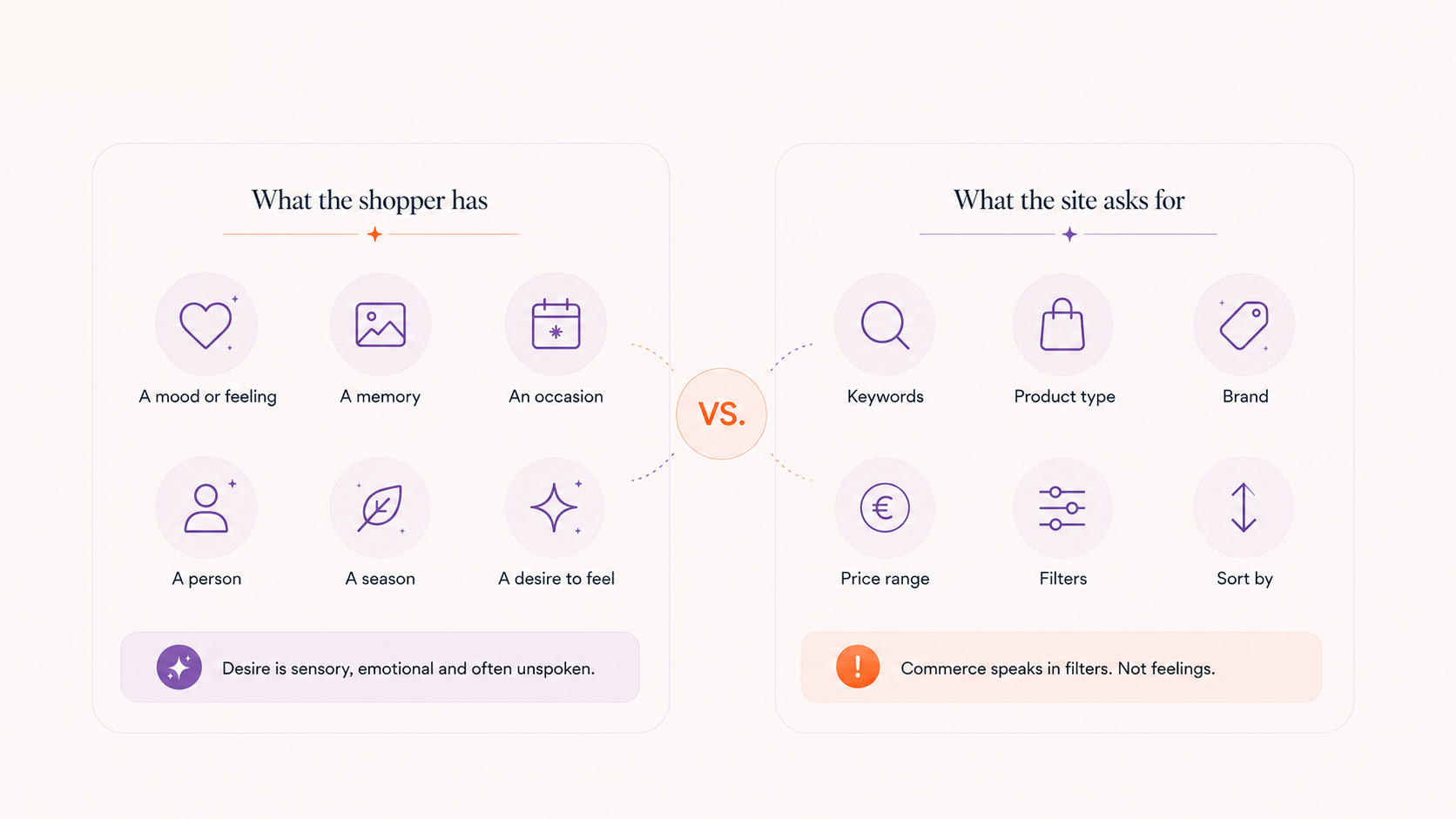
The deeper failure is linguistic.
Search requires the shopper to already know the words for what they want.
But beauty and fragrance desire is sensory and emotional before it is verbal.
Nobody necessarily arrives thinking: amber-forward resinous eau de parfum with a smoky drydown.
They arrive thinking about a season. A person. A memory. A dinner. The way they want to feel when they walk into a room.
And the interface hands them a keyword box.
This matters because traditional search begins after intent has already formed.
Yet in categories such as fragrance, beauty and fashion, some of the most commercially valuable discovery happens before that point.
The shopper doesn't always arrive looking for Product X.
They may arrive wanting to feel warmer, sharper, stranger, more polished, more confident, more themselves.
Good discovery doesn't merely fulfill demand.
It helps form it.
Search captures existing intent. Discovery can create new intent.
The categories where desire is hardest to articulate are therefore exactly the categories where guided discovery has the greatest potential value.
It's one reason the fragrance counter remains so powerful even as so much retail discovery has moved online: a good advisor translates feeling into product.
Discovery as an editorial experience
Product discovery should behave less like filtering a database and more like entering a curated world.
The shopper shouldn't need to understand the taxonomy of the catalog before they can navigate it.
The interface should do that translation for them.
A handful of retailers are already experimenting with this.
Instead of a quiz built from dropdowns, some are replacing it with identity-based entry points: evocative profiles a shopper can recognize themselves in rather than a form they have to complete.
Choosing a profile becomes an act of self-expression.
What follows is not simply a ranked product list, but a curated world of products mapped to that identity.
Browsing starts to feel closer to reading than searching.
The same principle applies to fragrance and scent discovery more broadly.
Instead of expecting shoppers to understand perfumery vocabulary, the entry point can begin with mood, memory, occasion and preference, then translate those signals toward products the shopper may never have known to search for.
None of this works without the commercial layer underneath it: live inventory, shopper history, availability, merchandising priorities, quietly supporting the experience rather than interrupting it.
Get that layer wrong and editorial discovery is just a prettier dead end.
The pattern is simple:
Lead with feeling. Translate through domain intelligence. Land on product.
This changes merchandising too
The implication isn't limited to the shopper interface.
It changes what merchandising itself can become.
Historically, a large part of digital merchandising has been about deciding which products deserve the most exposure.
But intelligent discovery opens a different question:
Under what circumstances would this product become exactly right for someone?
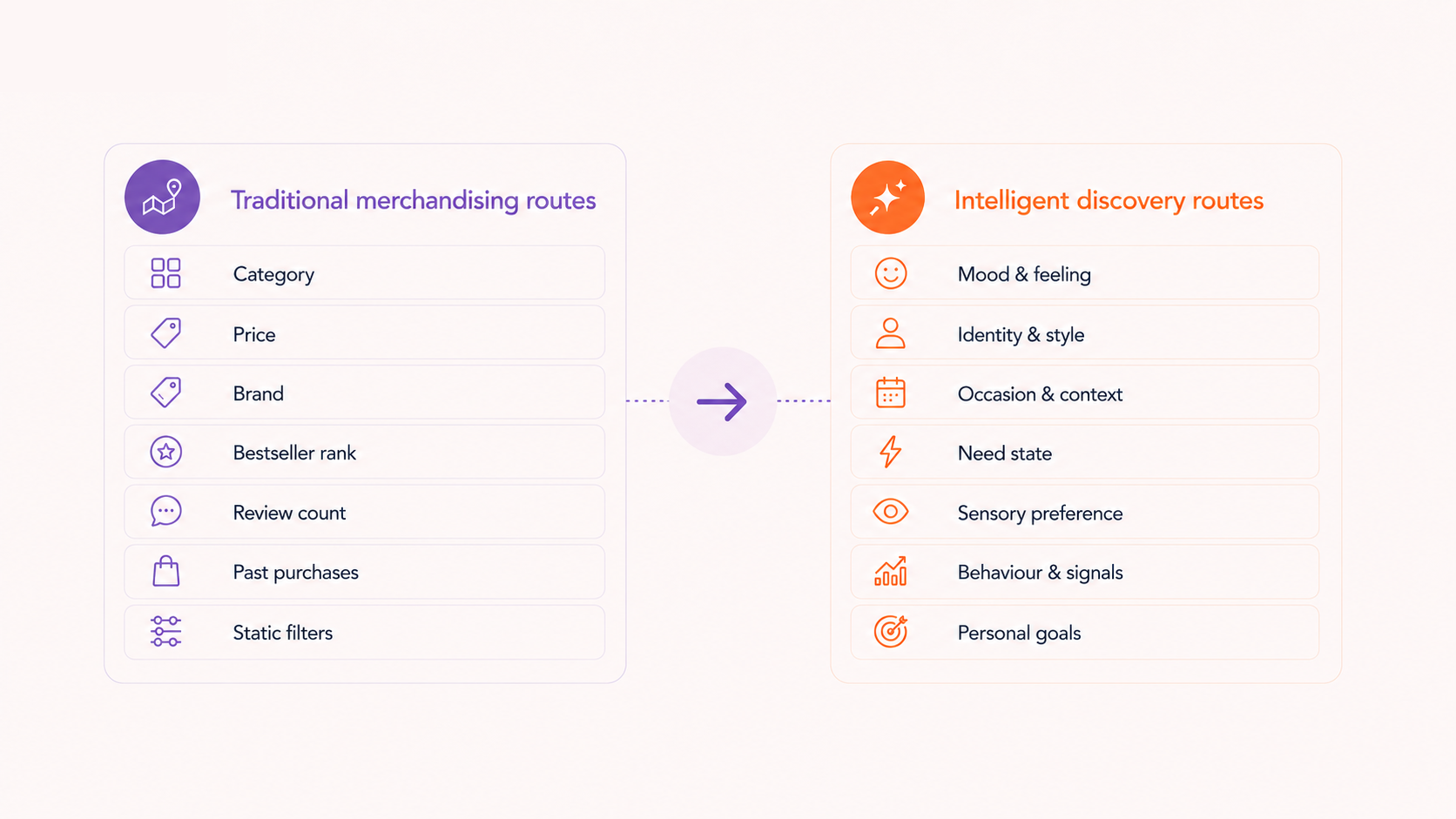
That means designing multiple routes into the assortment.
Not only category, price and brand, but mood, identity, occasion, need state, sensory preference, context and behavior.
A fragrance might be obscure in a bestseller ranking and perfect for someone searching for late summer in Sicily.
A lipstick may be invisible in a generic product grid but highly relevant to someone whose diagnostic profile, existing routine and color preferences make it an unusually strong match.
The catalog hasn't changed.
The intelligence surrounding it has.
And suddenly the long tail becomes discoverable.
What merchandising leaders should take from this
Audit your own discovery funnel with one question:
Can a shopper who lacks the vocabulary for what they want still find it on your site?
If the honest answer is no, you're primarily converting customers who arrive pre-decided.
Everyone else is being asked to navigate your assortment using terminology, filters and category structures designed by people who already understand it.
More filters won't fix that.
Neither will another bestseller carousel.
The digital storefront needs the capability the counter always had: to understand an uncertain shopper, interpret what they mean, and turn desire into discovery.